TL;DR
-
Cloud vs. On-Premise CLM: Both deployment models offer the same core contract lifecycle management (CLM) functionality, integrations, and security - but differ in scalability, control, and IT ownership.
-
Choose SaaS CLM for speed and scalability: Cloud-based CLM enables fast deployment, automatic updates, lower upfront costs, and remote access. It's ideal for growing, distributed enterprise teams.
- Choose On-Premise CLM for control and compliance: On-premise deployment provides maximum data sovereignty, customization, and alignment with strict regulatory or internal IT requirements.

Challenges in Selecting a CLM Deployment Model
Enterprise leaders face a critical dilemma when choosing between cloud vs on-premise contract management: balancing high-level data sovereignty with the need for operational agility. Selecting the wrong deployment model can lead to a system that either compromises internal security protocols or fails to provide the flexibility global teams require.
The stakes are high. If an organization chooses an on-premise system when it needs rapid scalability, it will be buried in hardware costs and IT maintenance. Conversely, if an organization opts for the Cloud without accounting for strict data residency requirements, it risks non-compliance and security vulnerabilities. Either mistake results in a wasted investment - a CLM that creates more friction than it resolves. This friction can lead to low user adoption and fragmented contract data.
A comprehensive, side-by-side comparison of cloud and on-premise contract management software deployments allows organizations to map their specific needs - such as total cost of ownership (TCO), security control, and integration requirements - against both models. In evaluating the benefits of both deployment types, organizations can help ensure that their CLM infrastructure aligns with long-term business goals.
Choosing SaaS (Cloud) CLM Deployment
Core Characteristics
- SaaS (Cloud) is usually an annual license subscription.
- It's hosted by the CLM provider and features a web-based browser and mobile access.
- It often includes hosting, support, and updates.
Benefits
- SaaS (Cloud) CLM features rapid deployment and faster activation (around 15 days) with minimal IT overhead and infrastructure requirements.
- Leading solutions offer multiple automatic software updates per year.
- SaaS supports high availability, disaster recovery, and daily backups with retention.
- Users can access remotely or on mobile via a web browser or a dedicated CLM mobile app.
- International datacenter options include those in the US, UK, Canada, and Australia for leading providers.
- Support and maintenance are often included in the subscription.
Choosing On-Premise (Deployed) CLM
Core Characteristics
- On-premise (deployed) CLM is usually offered as a one-time perpetual license.
- It's installed locally on the organization's servers.
- After the initial year, there is typically an optional annual support and maintenance fee.
Benefits
- On-premise (deployed) CLM provides full control over data, infrastructure, and security.
- It also supports compliance with internal IT policies, especially in highly regulated industries.
- Clients manage backups, storage, and upgrades.
- Organizations can arguably enjoy greater control over data residency and customization.
- Clients have discretion over upgrades.
- Delivery is typically within a month.

Similarities & Differences: Cloud vs On-Premise Contract Management
Similarities
Both cloud (SaaS) and on-premise (deployed) CLM solutions:
✅ Have the same core functionality for contract lifecycle management, including contract redlining and version control, complex approval workflow automation, clause library and template management, and more.
✅ Support integrations (REST APIs, MS 365, ERP/CRM, e-signature tools, etc.).
✅ Feature granular permissions, audit trails, encryption, and security controls.
✅ Allow clients to retain data ownership.
Differences
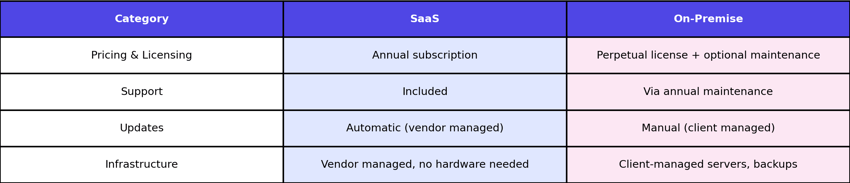
See the differences between cloud (SaaS) hosting and on-premise (deployed) hosting below.
Key Takeaway
The decision between SaaS (Cloud) and On-Premise CLM isn’t about functionality; rather, it’s about alignment. Both models deliver the same core capabilities, but the right choice depends on your organization’s priorities: choose SaaS for speed, scalability, and lower IT burden; choose on-premise for maximum control, customization, and strict data governance.
Selecting the model that aligns with your operational, regulatory, and growth needs is what ultimately drives long-term adoption and ROI.

Want to explore an award-winning CLM in action?
Book a free demo of CobbleStone today! It's free - and risk-free.
*Legal Disclaimer: This article is not legal advice. The content of this article is for general informational and educational purposes only. The information on this website may not present the most up-to-date legal information. Readers should contact their attorney for legal advice regarding any particular legal matter.